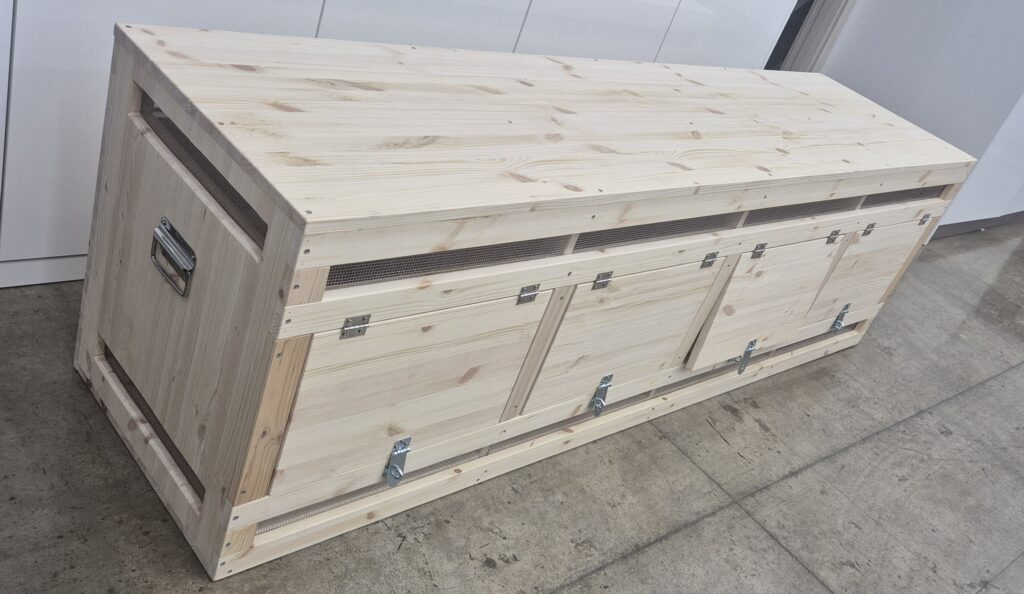
This model is a pure hardware baseline, representing the stage before the integration of advanced sensors or automated systems. Although it is currently in its ‘most basic state’—without add-on facilities such as automatic feeding and watering systems or internal waste buckets—it is engineered with exceptional durability and is fully ready for immediate deployment in standard live animal air transport and safe overland transit.
■ Key Features of the LV1 Basic Cage
- Sturdy Wooden Frame & Independent Multi-Doors: Constructed from thick, robust wood to withstand any impacts that may occur during transport. The compartmentalized, multiple-door design allows for easy boarding and individual management of the animals.
- Dual Ventilation System & Safety Mesh: Elongated slit-style vents are positioned across the upper and lower front sections to maximize air circulation. The interior is reinforced with a dense wire mesh, strictly ensuring the safety of the animals during transit.
- Secure Locking Mechanism & Mobility: Heavy-duty metal latches are equipped at the bottom of each door to completely prevent any accidental openings while on the move. Solid metal handles are attached to the sides, significantly enhancing convenience for handlers during loading and unloading.
Why Did We Start with the Simplest Wooden Cage?
“A flawless smart system can only operate on the most solid and secure foundation.”
The ultimate goal of O’s GloTure is clear: to perfect an ‘AI Smart Vivarium/Transport Platform’ that detects the condition of laboratory and companion animals down to the microsecond, while AI analyzes stress levels and autonomously provides early diagnosis solutions.
However, before installing flashy sensors and monitors, we went back to the most fundamental question: “What constitutes a physical space where animals remain safe and stress-free under the most extreme transport conditions?”
The Basic Wooden Transport Cage (LV1) we are unveiling today is our first answer to that question. Although it is currently in its purest hardware state (LV1)—without automation systems or AI technology—this sturdy wooden frame, independent multi-door system, and optimal ventilation design are the results of relentless iterations aimed at minimizing the physical shock and anxiety animals experience during long-haul air and land transport.
This seemingly rugged wooden box is, in fact, the most perfect and robust skeleton, designed to securely house the multitude of precision sensors and AI modules that will be integrated in the future.
V2. Mechanical(physical) Management Automation:
Integration of feeding, watering, and centralized video monitoring systems to maximize management efficiency.
V3. Sensor-Based Real-Time Data Logging:
Utilizing internal environmental sensors (temperature, humidity) and excreta (feces and urine) collection sensors to measure data in real time. This data is transmitted to an integrated platform to provide accurate environmental and metabolic results.
V4. AI-Driven Intelligent Analysis & Early Diagnosis (Final Stage):
- Condition Monitoring & Early Diagnosis: Detects subtle changes in the condition of laboratory/companion animals during transport and storage to provide early diagnosis of any abnormalities.
- Behavior-Based Analysis: Utilizes vision AI to analyze behavioral patterns and derive stress indices.
- Customized Action Plans: For researchers or handlers requiring direct management, the platform utilizes analyzed data